
Andy Warhol American, 1928-1987
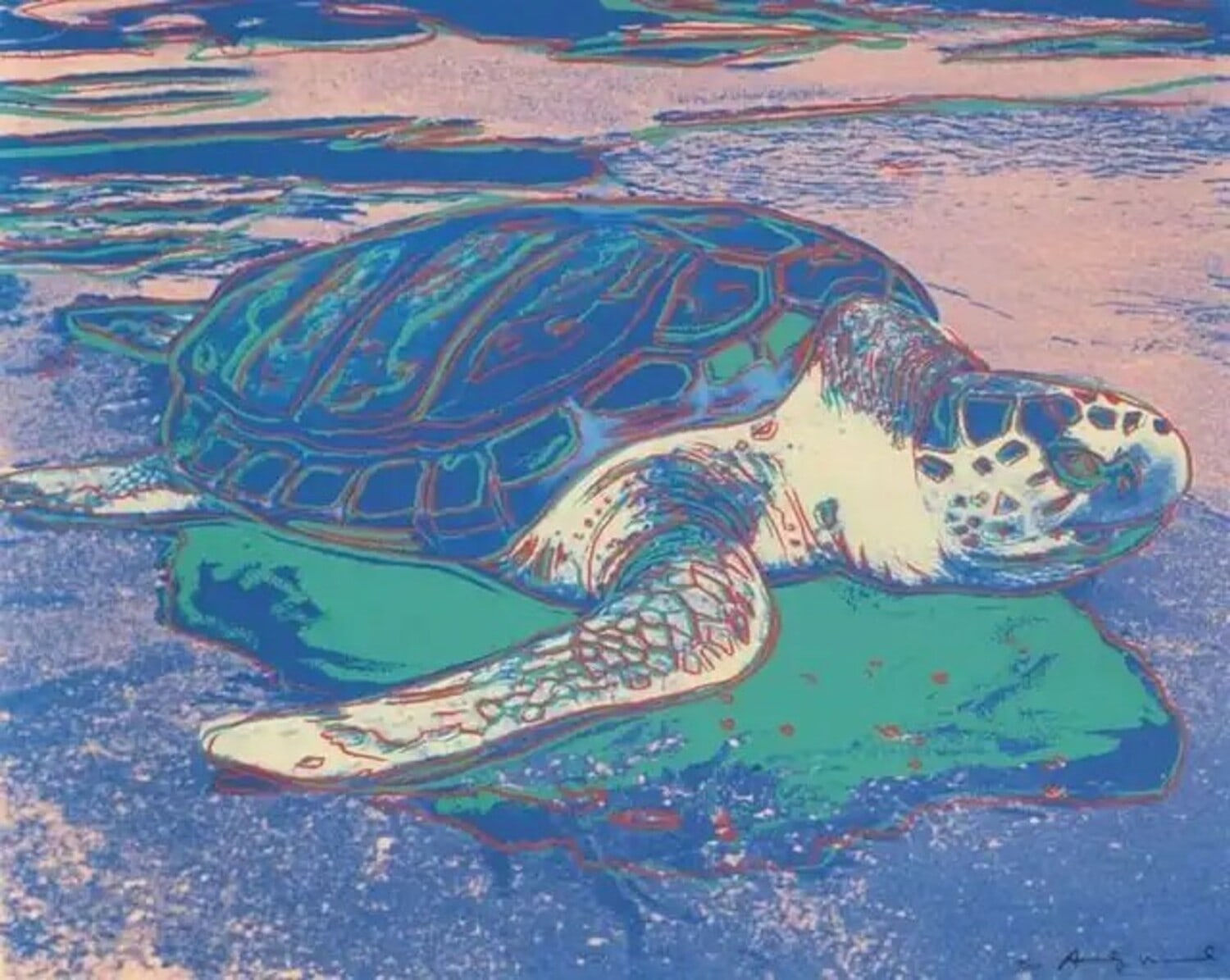
Turtle (FS II.360A), 1985
Screenprint on Lenox Museum Board
80 x 100 cm
31 1/2 x 39 37/100 in.
31 1/2 x 39 37/100 in.
Andy Warhol’s Turtle (FS II.360A) is a vibrant screenprint on Lenox Museum Board, created in 1985. The artwork features a solitary sea turtle rendered in Warhol’s distinctive Pop Art style—flattened,...
Andy Warhol’s Turtle (FS II.360A) is a vibrant screenprint on Lenox Museum Board, created in 1985. The artwork features a solitary sea turtle rendered in Warhol’s distinctive Pop Art style—flattened, brightly coloured, and outlined with bold, graphic contours. The turtle floats serenely against a contrasting background of vivid blues and greens, transforming a natural subject into an iconic, almost emblematic image.
The print combines realism and abstraction: the turtle’s recognizable form remains intact, yet Warhol’s use of non-naturalistic colour and screen-printing techniques lends it a synthetic, manufactured quality. Like much of his late work, Turtle reflects Warhol’s fascination with image production and repetition—treating even an animal subject with the same celebrity aura he gave to Marilyn Monroe or Elvis Presley.
Created in connection with the 1985 film Turtle Diary, the piece subtly evokes ideas of captivity and freedom. The turtle, an ancient and enduring creature, becomes a symbol of patience, protection, and survival amid an artificial, mass-produced world.
Through this work, Warhol extends his Pop vocabulary beyond human fame into the natural realm, inviting reflection on how images—whether of stars, products, or animals—are shaped, reproduced, and consumed by contemporary culture.
The print combines realism and abstraction: the turtle’s recognizable form remains intact, yet Warhol’s use of non-naturalistic colour and screen-printing techniques lends it a synthetic, manufactured quality. Like much of his late work, Turtle reflects Warhol’s fascination with image production and repetition—treating even an animal subject with the same celebrity aura he gave to Marilyn Monroe or Elvis Presley.
Created in connection with the 1985 film Turtle Diary, the piece subtly evokes ideas of captivity and freedom. The turtle, an ancient and enduring creature, becomes a symbol of patience, protection, and survival amid an artificial, mass-produced world.
Through this work, Warhol extends his Pop vocabulary beyond human fame into the natural realm, inviting reflection on how images—whether of stars, products, or animals—are shaped, reproduced, and consumed by contemporary culture.